🔑 Key Points
Vibe coding seems likely to be an AI-assisted programming method where developers use natural language to generate code, potentially transforming software development.
Research suggests it increases productivity, makes coding accessible to non-coders, and allows focus on creativity, but challenges like code accuracy and debugging remain.
The evidence leans toward vibe coding being used by startups and individuals for quick app development, with potential for future industry impact.
🌟 Introduction to Vibe Coding
Vibe coding is an emerging approach in software development, where developers describe what they want in natural language, and AI generates the code. Coined by AI expert Andrej Karpathy in February 2025, it shifts the focus from manual coding to guiding AI, making it accessible even to those without deep programming knowledge.
🔄 The Process and Benefits
The process involves describing ideas in prompts, letting AI generate code, and refining it. This can boost productivity, enable non-coders to create software, and free up time for creative design. However, challenges like ensuring code accuracy and debugging AI-generated code require human oversight.
🌍 Real-World Impact and Future Outlook
Startups and individuals are already using vibe coding for quick app development, like personalized tools or lean startup teams. Looking ahead, it seems likely to evolve, potentially democratizing software creation and reshaping the industry, though concerns about quality and security persist.
📑 Survey Note: Detailed Analysis of Vibe Coding in Software Development
🧩 Overview and Definition
Vibe coding, a term introduced by computer scientist Andrej Karpathy in February 2025, is an AI-dependent programming technique that relies on large language models (LLMs) to generate code from natural language prompts. This method marks a significant departure from traditional coding, where developers manually write code line by line, requiring extensive knowledge of programming languages and syntax.
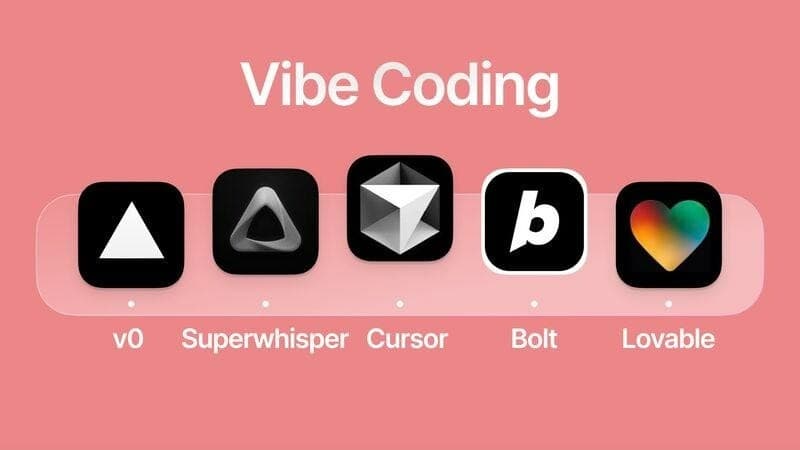
Instead, vibe coding allows individuals to describe their software ideas in plain English, with AI tools like Cursor Composer, GitHub Copilot, and Replit Agent translating these descriptions into functional code. This shift redefines the programmer's role, focusing on guiding, testing, and refining AI-generated outputs rather than writing code from scratch.
The concept gained traction quickly, with Merriam-Webster listing it as a "slang & trending" noun in March 2025, reflecting its rapid adoption in tech circles. It is particularly noted for enabling amateur programmers and non-coders to produce software, potentially democratizing the field.
🧠 Origins and Historical Context
The origins of vibe coding can be traced to the advancements in AI, particularly the development of LLMs capable of understanding and generating code from natural language.
Karpathy, a co-founder of OpenAI and former AI leader at Tesla, introduced the term in an X post on February 2, 2025, describing it as:
"A new kind of coding where you fully give in to the vibes, embrace exponentials, and forget that the code even exists."
This casual description highlights the intuitive, less technical approach, contrasting with traditional software development's emphasis on precision and control.
The rise of tools like ChatGPT (released in late 2022) laid the groundwork, with Karpathy noting in an X post at the time:
"The hottest new programming language is English,"
underscoring the potential of prompt-driven coding. Vibe coding builds on this, formalizing the practice with a catchy name that resonates in Silicon Valley and beyond.
🔧 The Process: How It Works
The vibe coding process is iterative and user-friendly, designed to simplify software development:
- Conceptualization: Developers or creators start by thinking about the desired functionality, such as building a simple website or a utility app.
- Prompt Creation: They articulate their idea in natural language, providing detailed prompts to the AI. For example:
"Create a React app that takes a photo of a restaurant menu, translates it, and shows a list of food with photos."
- Code Generation: The AI, using tools like Cursor or Replit, generates the corresponding code based on the prompt. This can include front-end, back-end, database integration, and more, depending on the complexity.
- Review and Refinement: The developer tests the generated code, identifies issues, and provides further prompts for adjustments. This might involve fixing bugs, enhancing features, or optimizing performance.
This process contrasts with traditional coding, where developers write every line manually, often requiring deep technical expertise. Vibe coding's reliance on AI shifts the burden, allowing for rapid prototyping and iteration, as seen in guides like Getting Started with Vibe Coding, which recommend starting with small projects to leverage AI effectively.
⚡ Benefits: Enhancing Productivity and Accessibility
Vibe coding offers several compelling benefits, supported by early adopters and industry observations:
✅ Increased Productivity: By automating code generation, developers can focus on higher-level design and functionality, significantly reducing development time.
Business Insider reports that engineers using AI tools can get "twice as much done," highlighting efficiency gains.
✅ Accessibility for Non-Coders: It lowers the barrier to entry, enabling individuals without formal coding training to create software.
Examples like New York Times journalist Kevin Roose, who used vibe coding to build "LunchBox Buddy" (a personalized app analyzing fridge contents for lunch suggestions), highlight this shift.
✅ Focus on Creative Aspects: With AI handling the technical details, developers can concentrate on user experience, design, and innovation.
Ars Technica describes vibe coding as "surrendering to the flow," emphasizing creative freedom.
These benefits are particularly appealing in industries where rapid prototyping and customization are valued, potentially accelerating software adoption in sectors like education, healthcare, and small businesses.
⚠️ Challenges: Navigating Accuracy and Oversight
Despite its promise, vibe coding faces several challenges that require careful consideration:
❌ Code Accuracy: AI-generated code may contain errors or suboptimal solutions, necessitating thorough testing.
Hacker News discussions highlight concerns about AI fabricating fake reviews in e-commerce apps, underscoring reliability issues.
❌ Debugging Difficulties: Understanding and fixing errors in AI-generated code can be challenging, especially for developers unfamiliar with the underlying logic.
As Ars Technica notes, the process often involves "feeding errors back to AI and hoping for fixes," which may not always work.
❌ Need for Human Oversight: Even with AI assistance, human intervention is crucial to ensure code quality, security, and compliance with standards.
Lovable Blog addresses this, noting concerns about long-term maintainability and security, particularly for critical applications.
These challenges suggest that while vibe coding is transformative, it is not a complete replacement for traditional coding—especially in complex or high-stakes projects.
🧪 Real-World Examples: Case Studies and Applications
Vibe coding is already being implemented across various contexts, demonstrating its practical utility:
🚀 Startups and Lean Teams: Y Combinator CEO Garry Tan, in an interview with Business Insider, highlighted how vibe coding enables startups to achieve significant revenue with small teams (e.g., reaching millions with under ten employees). This is attributed to AI handling much of the coding workload, allowing leaner operations.
👤 Individual Creators: Kevin Roose's experiment, detailed in Wikipedia: Vibe coding, involved creating "software for one," like LunchBox Buddy, showing how non-coders can build personalized tools.
Another example is a developer building a plane game with enemy UFO AI, as mentioned in 12 Rules to Vibe Code Without Frustration, illustrating hobbyist applications.
🧱 Full-Stack Projects: A Comprehensive Guide to Vibe Coding Tools catalogs tools for building full-stack apps, including front-end, back-end, and database integration—showing its versatility for more complex projects.
These examples underscore vibe coding's role in enabling rapid development and innovation, particularly for startups and individual creators.
🔮 Future Outlook: Potential Evolution and Industry Impact
The future of vibe coding appears promising, with potential to reshape the software development landscape:
🧠 Technological Advancements: As AI improves, vibe coding is likely to handle more complex tasks, potentially generating code with higher accuracy and sophistication.
Andrew Chen's Substack predicts adaptive software that adjusts based on user behavior, specified by outcomes rather than code, akin to spreadsheets for non-technical users.
🏭 Industry Transformation: It could democratize software development, allowing more industries to create custom solutions, as noted in UX Tigers, where it is seen as intent-based outcome specification.
This might accelerate software adoption in long-tail industries, as suggested by Andrew Chen.
🛡 Challenges and Controversies: However, concerns about code quality, security, and the need for professional oversight remain, as discussed in Hacker News, potentially increasing demand for specialized services to complement vibe coding.
The debate around whether traditional coding skills will remain relevant is ongoing, with figures like GitHub COO Kyle Daigle, in Moneycontrol, arguing that problem-solving skills are timeless, even as AI automates coding.
⚖️ Comparative Analysis: Traditional vs. Vibe Coding
| Aspect | Traditional Coding | Vibe Coding |
|---|---|---|
| Skill Requirement | High (programming languages, syntax) | Low (natural language prompts) |
| Development Speed | Slower, manual process | Faster, AI-assisted |
| Accessibility | Limited to coders | Open to non-coders |
| Debugging | Easier for coder, familiar with code | Potentially harder, less familiarity |
| Oversight Needed | Less, coder controls process | More, to ensure AI output quality |
📢 Conclusion and Call to Action
Vibe coding represents a paradigm shift in software development, offering increased efficiency, accessibility, and creativity. While challenges like code accuracy and debugging persist, its real-world applications in startups and individual projects demonstrate its transformative potential.
As AI continues to evolve, it seems likely to play a significant role in the future, potentially reshaping industry practices.
💡 For those interested, exploring tools like Cursor, GitHub Copilot, or Replit Agent can provide a hands-on introduction to vibe coding. Whether you're a seasoned developer or a curious beginner, now is the time to experiment and see how this approach can enhance your software creation process.